
Books by Alex Pawlowski
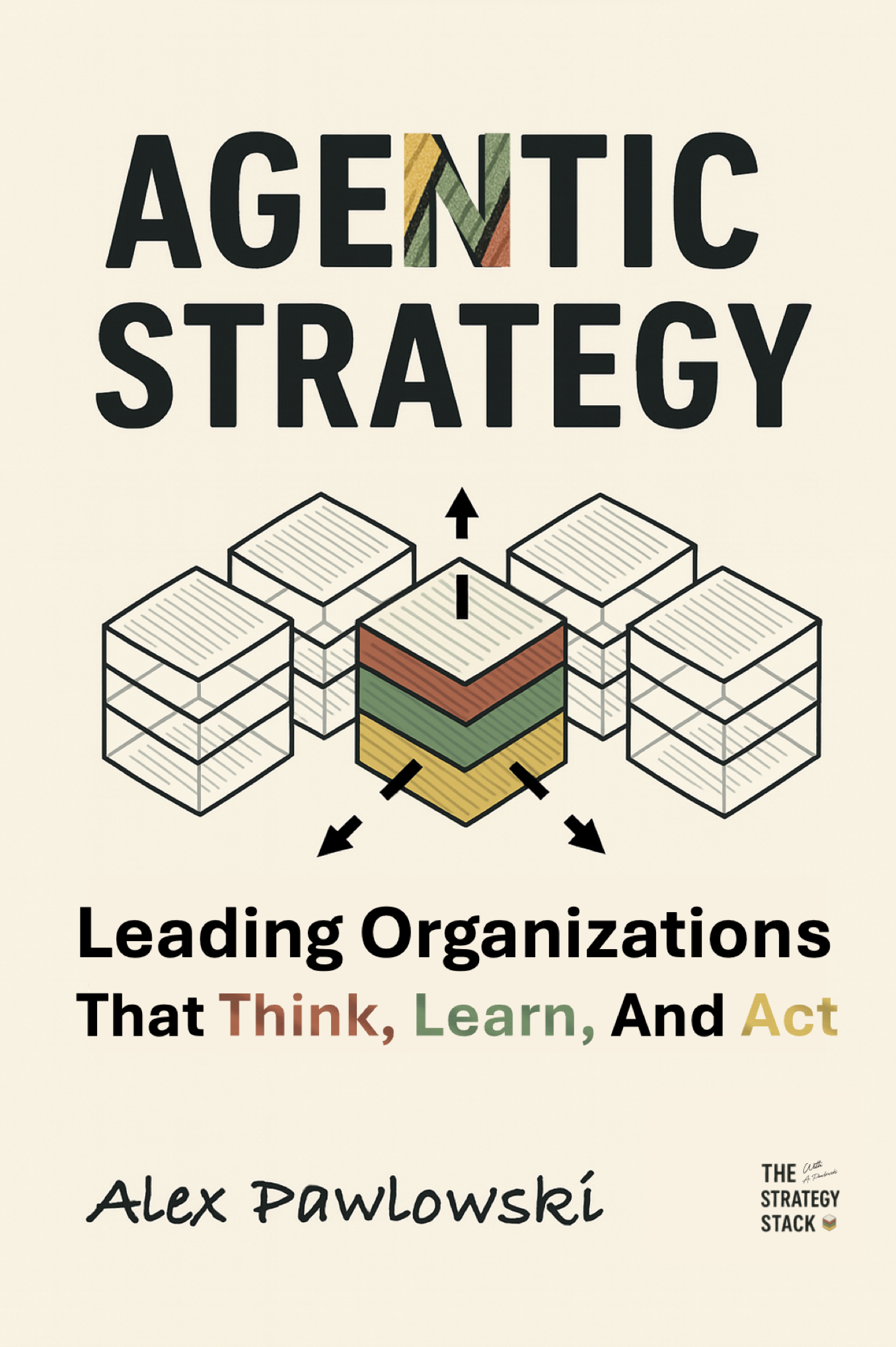
Agentic Strategy
AI is changing how organizations operate, but most adoption still sits at the tool layer: faster tasks and new features. Durable advantage depends on operating models, governance, and systems that can learn and coordinate over time.
Agentic Strategy is a practical field guide for leaders building AI-native organizations: how to move from tool-thinking to the Agentic Operating Model, a concrete AI operating model with agents, feedback loops, and trust designed in, not bolted on after the fact.
For operators, strategy and product leaders, and founders who own how work gets done, decision quality, and responsible scale, not only which software you buy.

Available worldwide on Amazon. Print and Kindle editions. Paid subscribers: download the full book in the Operator Vault.
- Design AI systems with governance and trust.
- Move from tool-thinking to agentic operating models.
- Build feedback loops that compound intelligence.

“A timely beacon for leaders navigating the AI economy, visionary yet practical.”
AI operating models, agentic AI, and enterprise execution
An AI operating model is how strategy turns into coordinated work when AI is in the loop: who decides, what data and tools agents touch, how handoffs work, and how the organization learns from outcomes, not a slide with a vendor logo.
Agentic AI in an enterprise setting means agents that pursue multi-step work with oversight: useful where the problem is partly execution, partly judgment, and partly keeping many moving parts aligned. It fails quietly when teams treat it as magic automation instead of operating design.
That is why governance, feedback loops, and explicit operating choices matter. Without them, AI agents in business settings create speed without accountability; with them, they become part of an enterprise AI strategy that compounds.
Agentic Strategy is written for leaders who need to move from isolated tools to AI operating model design, the same narrative the hero above points to, expanded here for readers who are searching for how the pieces fit before they commit to a free chapter or purchase.
Start here
If you are new to this topic, three orientations before you dive into the rest of the page.
What is Agentic Strategy?
The short version: an approach to enterprise AI strategy where AI agents in organizations support coordination and learning, not only isolated tasks. The full definition follows below.
Why does it matter now?
Most AI work still stops at tools and pilots. Durable advantage sits in operating models, an AI governance framework mindset, and feedback systems that hold as agents scale.
Who is this for?
Leaders, operators, founders, and strategy or product teams responsible for workflows, decisions, and AI-native design, not spectators of the hype cycle.
What is Agentic Strategy?
Agentic Strategy is a practical way to design organizations that use AI agents in organizations for coordination, learning, and execution over time, not only to speed up discrete tasks or ship isolated features.
It is not a catalogue of tools or prompts. It is an approach to the AI operating model and enterprise AI strategy: how work is structured, how decisions are made, and how an agent stack connects intent, data, governance, and feedback so the system can improve without losing accountability.
Where tool-first adoption stops at pilots and demos, Agentic Strategy asks how agentic AI, people, and oversight fit together as a durable operating pattern, so governance and feedback loops shape what gets built, not only what gets automated.
The book centers the Agentic Operating Model: a concise blueprint for aligning agents, workflows, and review rhythms with the outcomes you actually need, strategy, risk, and decision quality included.
If you are trying to name what “agentic” should mean in your organization beyond generic vendor language, this page, and the book, is written as that working reference.
What this book helps you do
- Define AI operating model design with an Agentic Operating Model that connects agents, people, data, and governance.
- Shape agent workflow design with clear accountability, trust boundaries, and review loops.
- Replace tool-only thinking with organizational coordination patterns that learn and adapt over time.
- Map your agent stack so intent, execution, and measurement stay aligned.
- Run strategic learning systems, feedback loops that improve decision quality and alignment instead of chasing one-off automation wins.
What changes after reading this
Rather than a bundle of new tools, it changes how you frame the work: from one-off AI wins to systems that hold up in real operating cadence.
Instead of
Evaluating isolated AI tools
Designing systems that learn, coordinate, and improve over time
Instead of
Pilot-stage automation wins
Operating models with accountability, review loops, and durable execution
Instead of
Shipping features faster
Improving decision quality, trust, and strategic alignment as agents scale
Instead of
Governance as a late-stage constraint
Governance as design input for the agent stack and feedback loops
Who it’s for

Operators & COOs
You get operating cadences, governance layers, and decision systems that keep agentic execution aligned with how the organization actually runs.

Strategy & Product Leaders
You get a way to translate agent capabilities into operating models, workflows, and measurable leverage on decision quality, not a disconnected AI roadmap slide.

Founders & Builders
You get a path from AI features to systems that learn, coordinate, and scale, with governance that stays credible as you grow.
What’s inside
Chapter-level themes you can apply in working sessions, written as modules, not slogans.
Operating model & AOM
- Designing the Agentic Operating Model (AOM) as a repeatable blueprint
- Agent stack design: roles, interfaces, orchestration, and handoffs
- Feedback loops that compound intelligence instead of one-off wins
Governance & trust
- Governance and trust patterns for safe, useful agent deployment
- Tool-thinking vs agentic thinking, and what changes in execution
- Trust, risk, and compliance as design inputs, not afterthoughts
- Long-horizon governance so agentic systems stay legible to the organization
Execution & metrics
- Operationalizing agents across teams, workflows, and cadences
- Decision systems that adapt while preserving accountability
- Metrics for strategic learning, agent performance, and risk signals
- Operator-facing patterns from real adoption constraints
Roadmaps & legibility
- Roadmaps from automation to agentic systems without losing control

Core frameworks

Agentic Operating Model (AOM)
A blueprint for where judgment, coordination, and execution meet, so agents support how decisions get made and work actually flows, not only how tasks get automated.
Tool-thinking vs Agentic thinking
The shift from one-off AI tasks to systems that observe, adapt, and act over time, with explicit accountability for what the organization learns and ships.
Governance + trust
How to set boundaries, review loops, and risk ownership so agents stay useful under real scrutiny, without defaulting to either paralysis or “move fast and ignore risk.”
Agent stack
A layer map for intent, data, tools, agents, and oversight, so teams know what must connect before an agent workflow is production-safe and measurable.
Start here: core essays on building agentic organizations
A tight reading path on AI operating models, agentic systems, strategy, defensibility, and execution, the same threads the book weaves into one reference.
Foundations
Strategy & advantage
Execution
If these essays resonate, the book pulls the same threads, Agentic Strategy, the Agentic Operating Model, governance, and the agent stack, into one working reference. Read a free chapter.
The Agentic Operating Model Canvas
The canvas is an AI operating model framework in template form: a single page for leaders, operators, and strategy teams to align on how agentic systems connect intent, data, tools, agents, and oversight before anything ships to production.
Treat it as a working sheet for the room, not a decorative summary: use the one-page view in your next planning session, working session, or team discussion. It brings agents, feedback loops, governance, and operating design into a single practical surface, so leaders and operators align on how work runs, not only which tools are live.
Coming soonWhile the canvas PDF ships, read the free chapter in the Operator Vault and use the AOM frameworks above in your next working session.
Common questions
What is Agentic Strategy about?
It is a field guide to operating models where business, technology, and intelligent systems meet: how organizations design for execution, governance, and learning when software and strategy are inseparable. The book is one pillar of The Strategy Stack, not the whole story.
Who is the book for?
Operators, strategy and product leaders, and founders who own how the organization runs: operating cadence, decision quality, coordination across teams, and the technology choices that shape execution. It is written for builders, not tool shoppers.
Is this only about AI?
No. AI and automation are part of the picture, but the frame is broader: business design, operating models, governance, and how technology changes the way organizations think, decide, and scale. The Strategy Stack sits at business × technology.
What is the Agentic Operating Model (AOM)?
A structured blueprint for how people, systems, data, and governance connect so the organization can learn and act over time, not only automate isolated tasks. It is the core framework the book develops and connects to the Operator Vault canvases.
Does the book cover governance and trust?
Yes. Governance, oversight, and trust are treated as design inputs: who owns decisions, how review works, and how to keep complex systems legible as they scale, not as compliance paperwork bolted on later.
Is there a framework or template I can use in workshops?
The Agentic Operating Model Canvas on this page is a one-page workshop template for leadership teams. When the PDF is live in Operator Vault, you can download it there. Until then, start with the free chapter and the recommended essays above.
Is this relevant outside of tech companies?
Yes. Any organization that must align roles, data, compliance, and operating reality with its technology stack faces the same structural questions. The framing is strategic and industry-agnostic.
Is this a tools or vendor book?
No. It is a systems book about judgment, accountability, and execution when technology is embedded in how the organization runs, not a survey of vendors, prompts, or gadgets.
Where can I read a free chapter?
Use “Read a Free Chapter” at the top of this page to download the Chapter 1 sample from the Operator Vault before you buy.
How long is the book?
Roughly 300 pages of practical guidance on operating models, business and technology strategy, governance, and execution design for leaders building at scale.

About the Author
Alex Pawlowski writes and advises at the intersection of AI systems, operating models, and strategic execution, advisor, speaker, and creator of the Agentic Operating Model for leaders building AI-native organizations.